
An example, due to Lakoff, of a Metaphor System in use.
Suppose that, for the first time ever, you’ve just heard the song lyric “We’re driving in the fast lane on the freeway of love.” How do you understand it?
You start by thinking about driving. I’ll list some such thoughts.
* If you’re on a freeway, you get to your destination sooner.
* There are fewer impediments – stop signs and whatnot – to your forward motion.
* In fact, you’ve probably deliberately chosen the route *because* it has few impediments and the least need to pay attention to your surroundings.
* Driving specifically in the fast lane suggests a certain impatience to get to your destination.
* You’re doing better at reaching your goal than the cars in the slow lane. (Quite likely, you’re exceeding the speed limit as you pass them.)
* There’s a certain excitement and even danger in driving in the fast lane: a crash would have worse consequences.
* **If traffic is heavy, you might find it hard to get over to the exit lane.**
Some of these connotations can then be mapped back from the Source Domain of a journey to the Target Domain of love. Love Is a Journey.
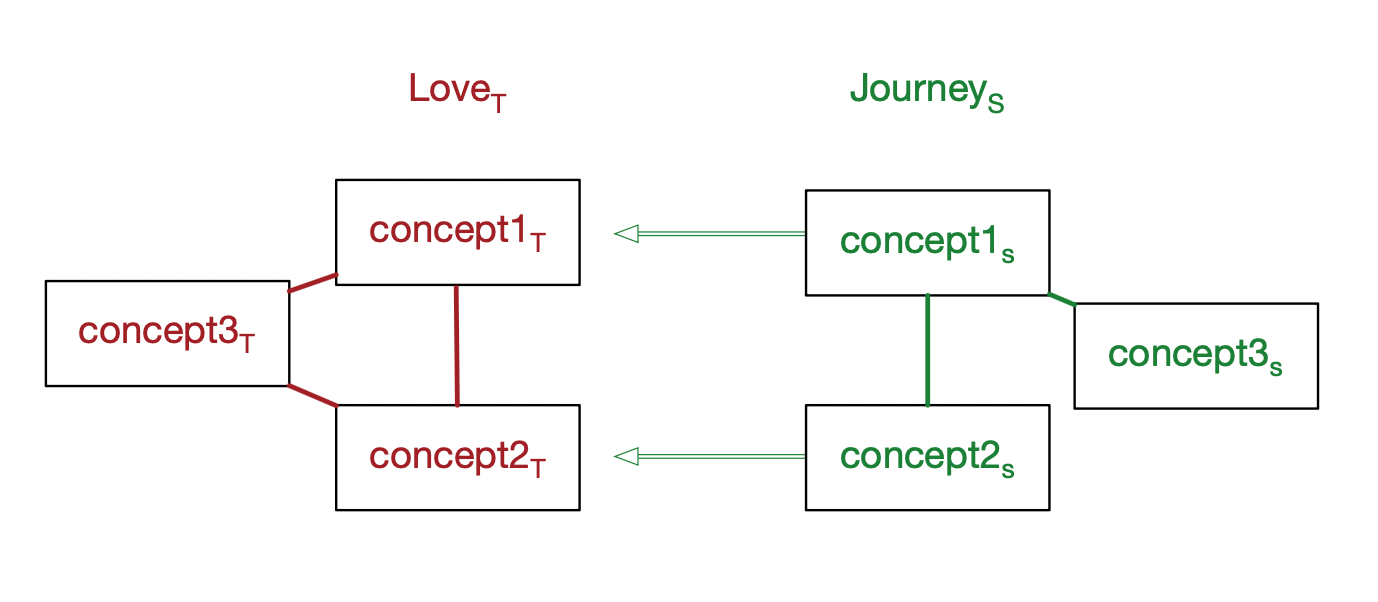
Mapping between source and target domains
The singer and her partner are likely having what another metaphor would call a whirlwind romance – one where the relationship, what’s carrying the lovers, feels out of their control. If the relationship fails, it will likely fail spectacularly. The lovers won’t be listening to the advice of their married friends. Their love affair is exceptional, compared to the plodding couples they see around them. Now, not all of the source’s connotations will find purchase in the target domain. What does taking the exit ramp mean in a love affair? You could come up with something – maybe getting divorced? – but probably, for most people, that’ll just be ignored. It will play no role in the *meaning* of the metaphor to that person.